


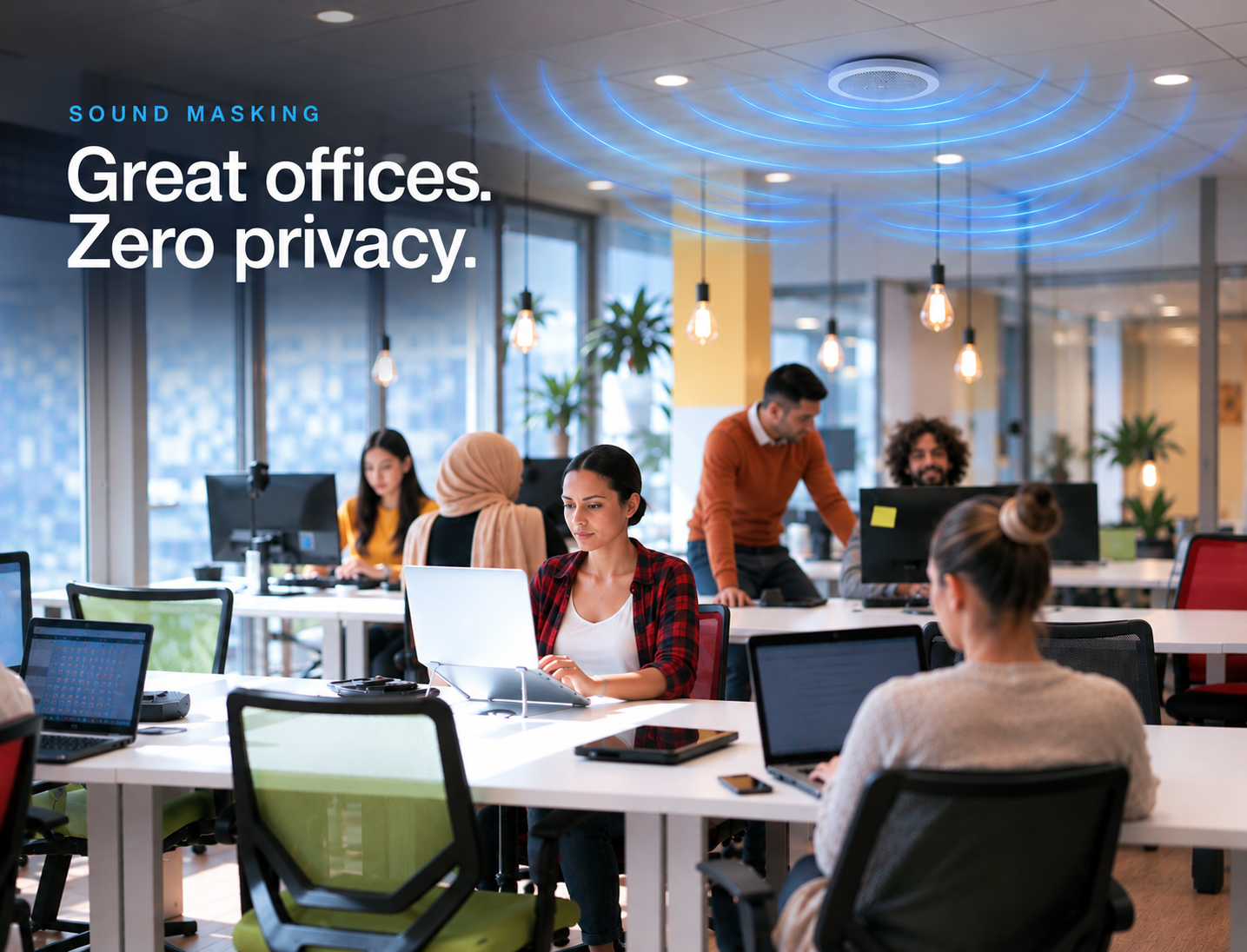
Walk into almost any modern office and you will hear the same problem. Open floor plans, glass walls, and hard surfaces look great, but they carry sound everywhere. A call in one corner becomes everyone's business, and a confidential conversation in a conference room is not as confidential as it should be.
Sound masking is the simplest fix most offices have never heard of. It is also one of the most effective.
Sound masking is the addition of a subtle, specially tuned background sound to a space, delivered through small speakers usually installed in or above the ceiling. The sound itself is barely noticeable, similar to soft airflow. What it does is raise the ambient sound level just enough that human speech becomes unintelligible at a distance.
A useful way to think about it: soundproofing tries to block sound, while sound masking makes speech private. Instead of building thicker walls, you reduce the distance over which a conversation can be understood. A voice that once carried forty feet might only be clear within ten.
Speech privacy. This is the headline benefit. Conversations stay where they belong, in the room where they started. For any business that handles sensitive information, that is not a luxury, it is a safeguard.
Better focus. In open offices, the number one distraction is not noise in general, it is intelligible speech. Our brains are wired to tune in to nearby conversations. When masking makes those conversations blend into the background, people concentrate longer and report less fatigue at the end of the day.
Consistent coverage. Unlike white noise machines or desk fans, a properly designed masking system is tuned zone by zone, so coverage is even across a floor. No hot spots, no dead zones, and no single loud corner speaker.
No construction. Masking systems install in the ceiling and can usually be deployed after hours with no downtime and no disruption to the workday. Compare that with the cost and mess of adding insulation, seals, or new walls.
A better client experience. Visitors notice when they can overhear the meeting before theirs. Masking makes a space feel calm, professional, and private from the moment someone walks in.
Law firms. Attorney-client privilege does not end at the conference room door, but sound travels right through it. Masking in hallways, waiting areas, and outside partner offices keeps privileged conversations privileged.
Open plan offices. Masking is the missing piece in most open layouts. It softens the acoustic chaos of sales calls, standups, and collaboration happening ten feet from someone trying to write a report.
Conference and huddle rooms. Glass-fronted meeting rooms are an acoustic weak point in nearly every new build-out. Masking just outside the room protects what is said inside it.
Financial services and insurance. Advisors discuss account details, claims, and personal financial information all day. Masking supports both client trust and the privacy obligations these industries carry.
Healthcare administration and clinics. Patient information is protected information. Masking in reception areas, corridors, and consult rooms helps keep conversations about care and billing from reaching the waiting room.
Human resources and executive suites. Performance reviews, terminations, negotiations, and board discussions are the most sensitive conversations in any company. Masking gives leadership spaces the privacy their conversations assume.
Call centers and customer support floors. Masking reduces cross-talk between agents, improves call clarity, and makes dense floors workable without dividers going up to the ceiling.
Not all masking is equal. A good system is engineered for the space: speaker layout matched to the ceiling plan, zones that follow how the office is actually used, and tuning done after installation so the level feels natural, not noticeable. It should also integrate cleanly with the rest of the office technology, from paging and background music to the AV in your meeting rooms.
If people can point to the sound, it is too loud. Done right, nobody notices the masking itself. They just notice that the office feels calmer and conversations feel private.
Corporate offices are only getting more open, more glass, and more collaborative, which means speech privacy is only getting harder. Sound masking solves that problem quietly, affordably, and without construction.
If you are planning a build-out, a renovation, or simply tired of hearing every conversation on your floor, it is worth a conversation about what masking coverage would look like for your space.
CK Technology designs and installs sound masking systems for offices across the New York metro area, tuned room by room and installed around your schedule.
Planning an upgrade? Contact CK Technology Group at sales@cktechnology.com to discuss your project.
